
Millions of people around the world live with communication disabilities caused by conditions like cerebral palsy, autism, and ALS. They rely on assistive communication – such as speech-generating devices and eye trackers – to express themselves. Yet many are unaware these tools exist or lack access due to limited financial coverage. Dynavox Group together with Augur has set out to change this.
The Challenge: Showcasing High-Tech AAC’s Impact and Expanding Access
Dynavox Group, the global leader in communication solutions for people with disabilities, partnered with us at Augur to support their mission: bring high-tech AAC (Augmentative and Alternative Communication) tools to more people. While the AAC community understands the life-changing impact of these tools, many potential users aren’t given the opportunity to use these tools.
To build a stronger case for improving access, Dynavox Group needed to measure the impact of AAC on users and caregivers, but also society as a whole.

The Solution: A Multi-Method, Explorative Study
To meet this challenge, Augur designed a multi-method study to bring a holistic understanding to the topic. The respondents used a wide range of AAC tools, not only Tobii Dynavox products. The focus was on the diagnostic groups cerebral palsy, autism, and ALS. The study launched in Sweden, followed by Germany.
Phase 1: Qualitative Pre-Study
In-depth interviews with AAC users, caregivers, and professionals explored subjective needs, behaviors, and the emotional experience of using AAC.
Phase 2: Quantitative Study
An open-access online survey gathered data from high-tech AAC users and caregivers, assessing their current experience and comparing it to a hypothetical scenario without high-tech AAC.
Phase 3: Health Economic Model
A health-economic model was designed to measure the costs and gains for society following the introduction of high-tech AAC tools.
The Results: Quality of Life Doubled, ROI Delivered
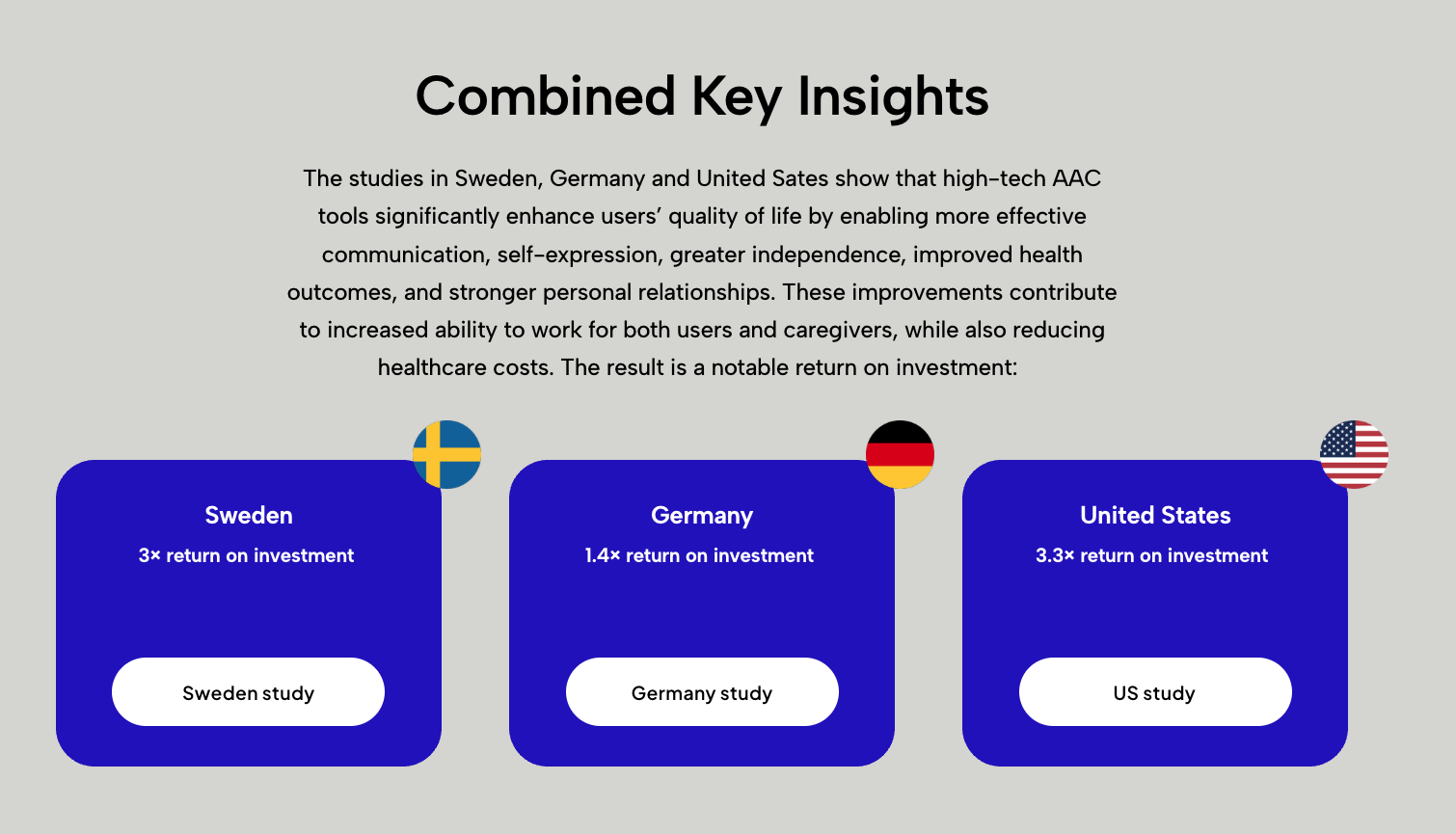
The studies in both Sweden and Germany show that high-tech AAC tools significantly enhance users’ quality of life by enabling more effective communication, self-expression, greater independence, improved health outcomes, and stronger personal relationships.
These improvements also boost work capacity for users and caregivers while lowering healthcare costs. The result? Strong returns on investment:
- 3x ROI in Sweden
- 1.4x ROI in Germany
“The study demonstrates that assistive communication has the power to substantially improve the quality of life for people with disabilities, while at the same time paying for itself three times over. By commissioning this report, we wish to raise awareness and help guide political decisions to support more people with disabilities in getting access to the communication aids they need.”
Fredrik Ruben, CEO of Dynavox Group, about the Swedish report
The Impact: Proof Points That Move the Needle
The studies filled a long-standing knowledge gap and have been welcomed by the AAC community. Advocates now have powerful, data-backed proof points: AAC not only transforms lives – it pays off for society.
“The ability to make yourself understood and to be able to tell others how you feel or what you want is crucial for members of Neuro. The health economic study clearly shows that we must change today's overly restrictive and unequal access to communication aids.”
Lise Lidbeck, Chair of the Swedish patient organization Neuro
The findings have been widely shared through articles, conference talks, and panel discussions – both within Dynavox Group and externally. The significant need for these tools is also reflected in results: since 2021, Dynavox Group, has seen 126% revenue growth (89% fx-adjusted).
Read more about the studies and download the full reports here: